



For over two decades, Virtual Private Networks (VPNs) served as the standard for secure remote access. Built for an era when enterprise applications lived in on-premises data centers, VPNs extended a secure perimeter to remote endpoints. Multi-cloud workloads, SaaS adoption, and distributed workforces have exposed structural limits in that model - and Zero Trust Network Access (ZTNA) has emerged as the identity-centric alternative.
1. Traditional VPN Architecture (The "Implicit Trust" Model)
A traditional VPN relies on network-level access (Layer 3 or Layer 4 of the OSI model). To connect, a remote user initiates a connection request to a physical or virtual VPN gateway (concentrator) exposed on a public IP address at the perimeter of the enterprise network.
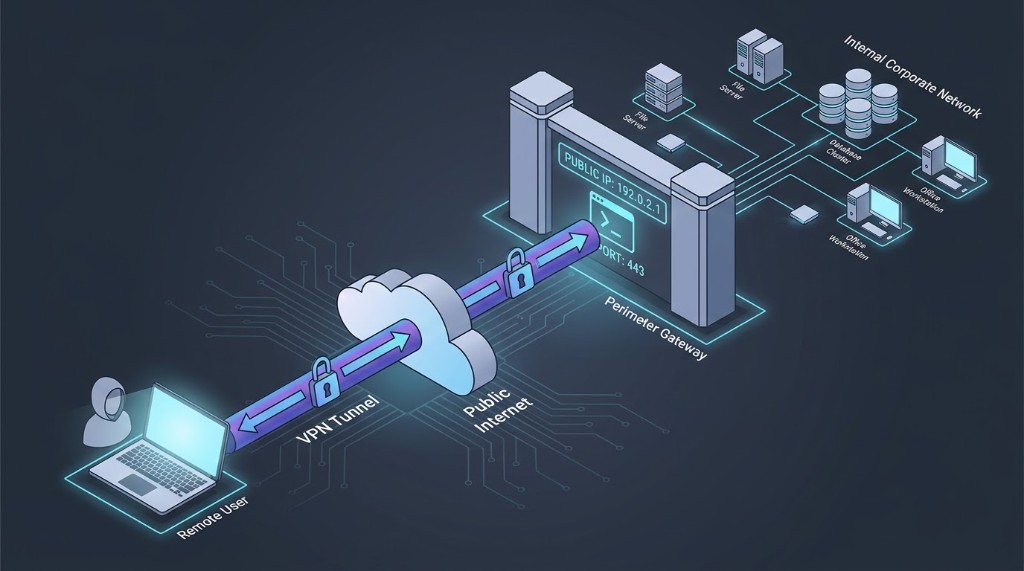
The Authentication and Connection Flow
- Tunnel establishment: The client establishes an encrypted IPsec (Layer 3) or SSL/TLS (Layer 4) tunnel with the VPN gateway.
- Authentication: The gateway prompts for credentials (password, certificate, or multi-factor authentication). This is a single, one-time event at session initiation.
- Address assignment: Upon verification, the gateway assigns the remote device a virtual IP address belonging to the internal LAN.
- Implicit trust: The device is treated as if it were physically plugged into an office ethernet port. It gains broad visibility over internal subnets and can route traffic to any accessible resource.
2. Structural Vulnerabilities of Traditional VPNs
The "connect first, authenticate second" nature of VPNs introduces several severe security risks:
- Excessive lateral movement: Because VPNs grant network-level access, compromised credentials let an attacker bypass the perimeter entirely. They can scan networks, enumerate open ports, exploit unpatched services, and move laterally to high-value assets such as databases and domain controllers.
- Exposed attack surface: A VPN gateway must listen on a publicly discoverable IP address to accept inbound remote connections. That makes it a constant target for automated scanners, DDoS attacks, and exploitation of unpatched firmware.
- Lack of posture awareness: Traditional VPNs typically authenticate the user, but pay little attention to endpoint health. A compromised laptop with outdated patches and disabled protection can receive the same network access as a hardened corporate device if the credentials are valid.
- The hairpinning performance bottleneck: In a cloud-first landscape, a full-tunnel VPN forces SaaS traffic (such as Microsoft 365 or Salesforce) through the corporate data center for policy enforcement. This backhauling degrades performance and taxes bandwidth.
3. ZTNA Architecture (The "Never Trust, Always Verify" Model)
ZTNA is an application-level (Layer 7) access control framework that enforces least privilege. Users are never placed on the corporate network. Instead, they receive secure, direct connections to specific authorized applications, while the rest of the network remains invisible.
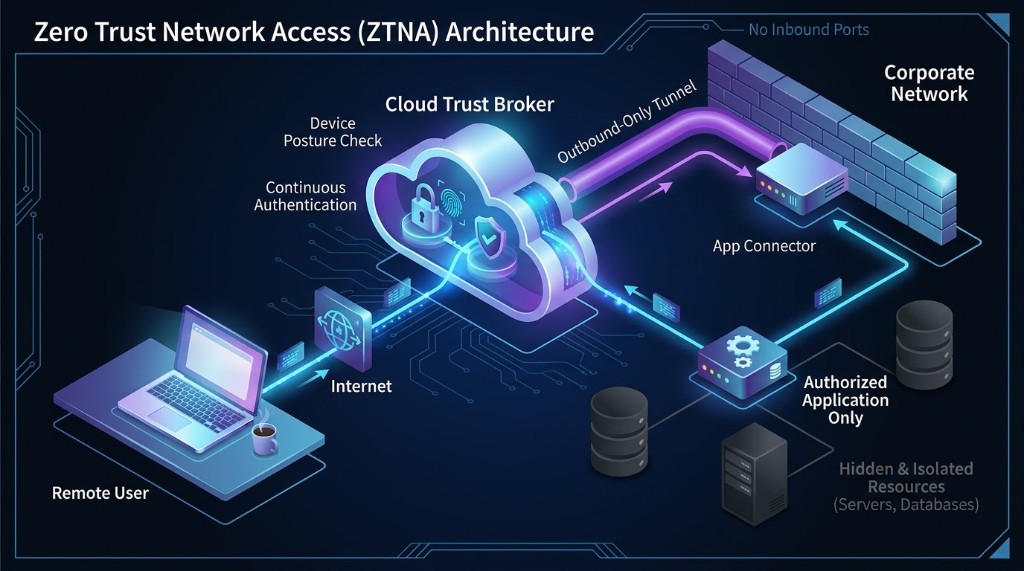
The Decoupled Control and Data Plane Flow
- Identity and posture evaluation (control plane): The client requests access to a specific application. A policy engine (typically a global cloud broker) verifies identity via an IdP and evaluates contextual signals such as patch level, endpoint security agents, location, and time of day.
- The outbound tunnel (data plane): An Application Connector inside the private network hosting the app establishes a secure, outbound-only tunnel to the ZTNA cloud broker. No inbound firewall ports are opened, and no public IP addresses are exposed for that path.
- Dynamic broker bridging: If and only if the policy engine approves the request, the broker binds the client's session to the connector's outbound tunnel and proxies the user to the authorized application.
- Application invisibility: Because the connection is established at Layer 7, the client has no visibility into the broader network. The user cannot ping, scan, or see other servers or databases on the same subnet.
4. Technical Comparison: ZTNA vs. Traditional VPN
Key architectural and operational differences between the two remote access approaches:
| Aspect | Traditional VPN | ZTNA |
|---|---|---|
| OSI layer | Layer 3 (Network) or Layer 4 (Transport) | Layer 7 (Application) |
| Access scope | Broad network-level access to entire subnets | Granular per-application access (least privilege) |
| Default trust | Implicit trust once authenticated | Default deny; zero implicit trust |
| Gateway visibility | Public-facing IP; open inbound ports | Closed inbound ports; hidden via outbound-only tunnels |
| Lateral movement | Highly possible after compromise | Prevented; isolated to a single application proxy session |
| Authentication | One-time at session start | Continuous throughout the session |
| Device posture | None, or limited static checks | Continuous telemetry (OS patch, EDR, disk encryption) |
| Routing | Hub-and-spoke; backhauling / hairpinning | Edge-routed to the closest cloud point of presence |
| User experience | Manual connect/disconnect; higher latency | Transparent, always-on, optimized for remote users |